
Visit to St Mary’s Wreay and the Legacy of Sarah Losh
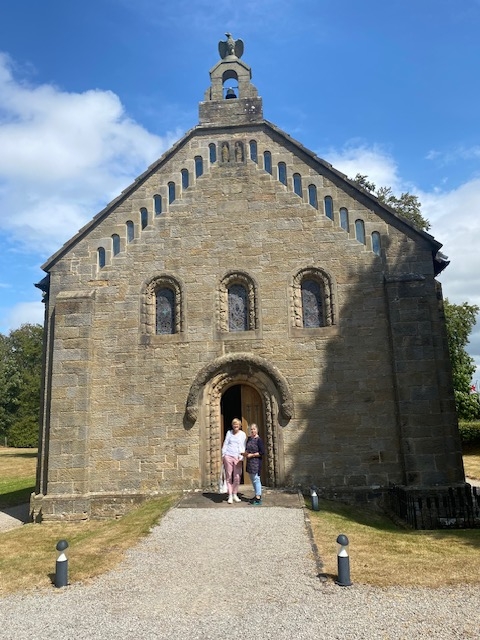
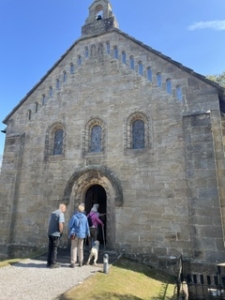 On 28th July 16 of us (David driving the minibus!) travelled to Wreay, just south of Carlisle, to visit St Mary’s, the Pinecone church, built between 1840 and 1842 by Sarah Losh. Sarah was the daughter of John Losh, whose family owned an alkaline mill in Newcastle, from which (and from whose workers) they derived their wealth. Sarah and her sister Katherine inherited their father’s estate. Neither married; and Sarah inherited Katherine’s share on her death in 1835. She spent her money on building projects enhancing Wreay.
By 1840 the old church in Wreay was in a poor state and Sarah offered to give land and pay to replace it, provided that she had a free hand with its design. Sarah and her sister had done the ‘Grand Tour’ of Europe at the end of the Napoleonic wars; and this clearly provided various inspirations for her design of the church, which can perhaps most politely be described as eclectic. The church was completed by December 1842.
Sarah based her design on early Christian basilicas, with an aisle-less rectangular nave ending in a semi-circular apse. She apparently termed the style “early Saxon or modified Lombard”. The church is decorated with naturalistic stone carvings of fossils, plants and animals and lots of pine cones. These may have bee
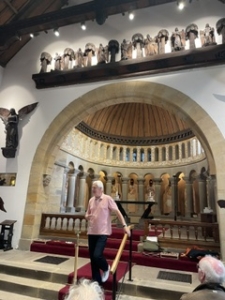
n a tribute to her schoolfriend, (Major) William Thain, to whom, despite never marrying, she might (or might not) have been romantically attached. He had sent her a pine cone from Afghanistan, shortly before he was killed in the Khyber Pass in 1842 in the retreat from Kabul, which has been described as the worst military disaster in British Imperial history.
In the twentieth century the results of her labours were compared by Nikolaus Pevsner to the later ‘arts and crafts’ movement; and indeed there are ‘arts and crafts’ additions to the church. There are virtually no explicit Christian symbols (there was a tiny cross hiding out of sight at the back when we were there), but we were told the church does now put a real cross on its altar for Sunday services.
Wikipedia records that ‘the profusion of decoration has been seen by some as a celebration of creation’. This decodes as nature worship, so Sarah’s own theological beliefs are anyone’s guess. From the bookstall in the church I bought a copy of ‘A spiritual guide to St Mary’s, Wreay’, written by one Rev Nick Ash (Vicar at Wreay for 5 years before becoming Team Rector at St Paul’s). It reads as an attempt to provide a kind of missing link between the symbols of nature in the church and appropriate biblical texts to which they might be related. Nick appears to have wanted to provide an explicitly Christian context for these symbols, of which you would not be aware from just walking round the church.
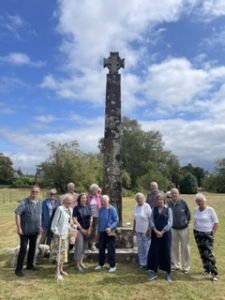 The Mausoleum Sarah built for the sister Katherine is even more bizarre – a beautiful classical statue of Katherine (gazing down at a pine cone), but encased in a crude stone box that has been variously described as Druidic, semi-Celtic, Cyclopean and archaic. Given that Sarah was supposed to have been devoted to her sister, it’s even more odd. All in all, it was an interesting visit to a unique and very different kind of church.